2

Learning Fourier-Constrained Diffusion Bridges for MRI Reconstruction
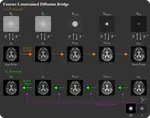
Although MRI reconstruction requires a dealiasing transformation from undersampled to fully-sampled data, task-agnostic diffusion priors sample images via a denoising-based generative trajectory from an asymptotic start-point of Gaussian noise onto fully-sampled data. Since aliasing artifacts in MR images carry spatial structure deviating from Gaussian noise, this noise-governed trajectory can cause suboptimal artifact suppression. To address this limitation, we introduce the first Fourier-constrained diffusion bridge (FDB) for MRI reconstruction in the literature. Unlike task-agnostic diffusion priors, FDB does not rely on noise in its forward process and instead learns a dealiasing transformation between a start-point of undersampled data and the end-point of fully-sampled data. The start-point is derived via a stochastic Fourier-constrained degradation operator that removes a progressively growing set of spatial frequencies. Unlike cold/soft diffusion priors that use an asymptotic start-point of severely degraded measurements, FDB uses a realistically undersampled start-point to ensure closer alignment of model input between training and test distributions. Unlike existing diffusion bridges that use degradations based on weighted linear averages and noise addition, FDB implements degradations based on binary removal of compact k-space sets to conform to the physics of accelerated MRI. To further improve image quality, FDB leverages a novel sampling algorithm based on progressive dealiasing by continually correcting recovered k-space data across reverse diffusion steps.
Learning Fourier-Constrained Diffusion Bridges for MRI Reconstruction
One Model to Unite Them All: Personalized Federated Learning of Multi-Contrast MRI Synthesis
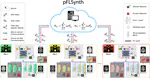
Curation of large, diverse MRI datasets via multi-institutional collaborations can help improve learning of generalizable synthesis models that reliably translate source- onto target-contrast images. To facilitate collaborations, federated learning (FL) adopts decentralized model training while mitigating privacy concerns by avoiding sharing of imaging data. However, conventional FL methods can be impaired by the inherent heterogeneity in the data distribution, with domain shifts evident within and across imaging sites. Here we introduce the first personalized FL method for MRI Synthesis (pFLSynth) that improves reliability against data heterogeneity via model specialization to individual sites and synthesis tasks (i.e., source-target contrasts). To do this, pFLSynth leverages an adversarial model equipped with novel personalization blocks that control the statistics of generated feature maps across the spatial/channel dimensions, given latent variables specific to sites and tasks. To further promote communication efficiency and site specialization, partial network aggregation is employed over later generator stages while earlier generator stages and the discriminator are trained locally. As such, pFLSynth enables multi-task training of multi-site synthesis models with high generalization performance across sites and tasks. Comprehensive experiments demonstrate the superior performance and reliability of pFLSynth in MRI synthesis against prior federated methods.
One Model to Unite Them All: Personalized Federated Learning of Multi-Contrast MRI Synthesis